
LDC Watch Calls for Stronger Global Partnerships at the Asia‑Pacific Ministerial Meeting on the Mid-term Review of the DPoA, Hosted by the Government of Cambodia and Organized by UN‑ESCAP & UN‑OHRLLS
Phnom Penh, Cambodia | 31 March-01 April 2026
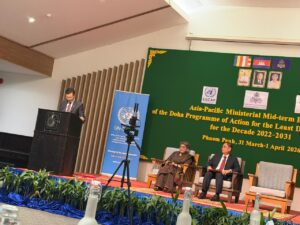 As the Asia-Pacific region enters an unprecedented wave of Least Developed Country (LDC) graduations, LDC Watch has called for stronger and more coordinated international partnerships to ensure a smooth and sustainable transition. Nepal, Bangladesh, and the Lao People’s Democratic Republic are set to graduate in 2026, followed by the Solomon Islands in 2027 and Cambodia in 2029.
During the Asia-Pacific Ministerial Meeting on the Mid-term Review of the Doha Programme of Action (DPoA), held in Phnom Penh, Cambodia, and hosted by the Government of Cambodia, and jointly organized by UN-OHRLLS and UN-ESCAP from 31 March to 1 April 2026, LDC Watch actively contributed to discussions on mobilizing international partnerships for sustainable graduation.
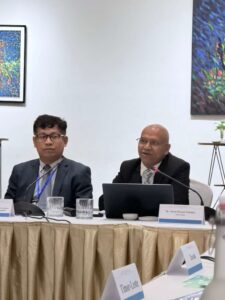 Speaking on behalf of LDC Watch, Netra Prasad Timsina, a panelist in the session, highlighted that while graduation marks significant progress, it remains a fragile phase requiring sustained, predictable, and coordinated support. He warned of the risks of a ‘graduation cliff’ if international support mechanisms are withdrawn prematurely.
He further emphasized that graduating LDCs remain highly vulnerable to global uncertainties beyond their control. Ongoing geopolitical tensions, particularly in the Middle East, are already affecting remittance-dependent economies like Nepal, threatening livelihoods, reducing remittance inflows, and increasing inflationary pressures through rising fuel and commodity prices.
LDC Watch called for a shift from short-term assistance to long-term, country-led partnerships aligned with national priorities. Speaking on its behalf, he stressed the need to prioritize social resilience, local capacity, and community preparedness to sustain development gains. He also emphasized scaling up innovative financing, including blended finance, debt and climate swaps, and SDG-linked instruments, ensuring they remain transparent and focused on social protection and climate resilience.
LDC Watch further urged the operationalization of the iGRAD facility and called for continued support beyond graduation, stronger global cooperation, and greater civil society participation.
He reaffirmed that graduation should be a managed, inclusive, and resilient transition that safeguards development progress.
