
The devastating Rasuwa–Gyirong event of 26 August 2026 has highlighted the growing risks facing mountain communities and the urgent need for stronger hazard monitoring, effective early warning systems, transboundary cooperation and accessible climate finance. These issues were discussed at a session titled “What the Rasuwa–Gyirong Event Tells Us About Mountain Risk, Warning Systems, and Climate Responsibility” at the Nepal Pavilion during COP31 on 17 November 2026. The session was organised by the International Centre for Integrated Mountain Development (ICIMOD) and UK International Aid.
The discussion examined the cascading impacts of the 26 August disaster, when a massive rock–ice avalanche from Langtang Lirung developed into a debris flow and high-velocity surge, affecting communities along the Bhote Koshi, Trishuli and Narayani river systems in Nepal and across the border in China. More than 1,400 people lost their lives, thousands remain missing and over 84,000 people were affected. The estimated recovery and reconstruction requirement is approximately USD 4.8 billion.
A key concern raised during the discussion was that mountain risk assessments and early warning systems remain insufficient to address hazards beyond glacial lake outburst floods. Unstable rock–ice slopes, cascading hazards and rapidly developing mountain events require more comprehensive monitoring, risk mapping and preparedness measures. Communities living close to hazard sources need timely warnings and locally accessible response systems.
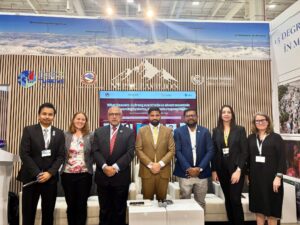
The discussion also highlighted the importance of transboundary cooperation between Nepal and China. Since mountain hazards and their impacts do not follow national boundaries, effective risk reduction requires joint cryosphere monitoring, real-time information sharing, coordinated early warning protocols and stronger institutional collaboration.
Representing Nepal in the discussion, Dr. Arjun Kumar Karki, Member of the House of Representatives of Nepal and one of the founders of LDC Watch, emphasised the need to strengthen political and institutional accountability for mountain risk governance. He highlighted the importance of community-led preparedness, risk-sensitive planning and protecting vulnerable mountain communities, particularly women, Indigenous Peoples and other marginalised groups.
The financing gap for recovery and reconstruction was another major concern. Nepal’s estimated requirement of approximately USD 4.8 billion stands in sharp contrast to the USD 21.6 million provisionally set aside for the country by the Fund for Responding to Loss and Damage (FRLD). This gap underlines the need for predictable, adequate and accessible international support for countries experiencing severe climate-related and cryosphere disasters.
The discussion stressed that loss and damage finance is a matter of climate justice and international responsibility, not charity. Ahead of the FRLD Board meeting scheduled for 15 December 2026, the need for stronger coordination among Least Developed Countries (LDCs) and Global South countries was highlighted to advance mountain and cryosphere-related risks within the Fund’s financing framework.
Key priorities included new and predictable grant-based public finance, simplified and direct access to the FRLD, and consideration of a dedicated financing window for rapid-onset mountain and cryosphere disasters. The discussion also underscored the importance of connecting parliamentary engagement, scientific evidence and community experiences in advancing climate accountability.
The session brought together experts and practitioners to examine lessons from the Rasuwa–Gyirong event and identify ways to strengthen mountain risk governance, early warning systems and international cooperation. The discussions reinforced the need to recognise the specific vulnerabilities of mountain countries in global climate policy and ensure that affected communities receive timely protection and adequate resources for recovery.
