
LDC Watch joined regional movements and civil society organisations in advancing the Global South’s demands for climate finance and climate justice at a COP31 side event titled “The Imperatives and Prospects for Climate Finance: Perspectives from the Global South”, held on 10 November 2026 at the Antalya Expo Center in Türkiye.
The event was jointly organised by the Asian Peoples’ Movement on Debt and Development (APMDD), LDC Watch, Environics, COAST Trust and the Center for Participatory Research & Development (CPRD). It brought together representatives of civil society organisations, climate movements and policy advocates to discuss the state of climate finance negotiations at COP31 and strategies for strengthening the Global South’s collective demands.
The discussion examined key issues in the climate finance negotiations, including the implementation of Article 9.1 of the Paris Agreement under the Climate Finance Work Programme, the status of existing climate finance channels such as the Green Climate Fund, Adaptation Fund and Fund for Responding to Loss and Damage, and the urgent need to scale up finance for adaptation and loss and damage. Speakers also highlighted the growing concerns over debt-creating climate finance and the role of international financial institutions in shaping the global climate finance architecture.
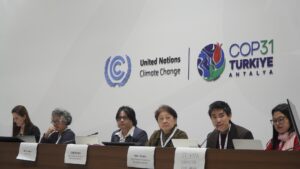
Representing Nepal, Hon. Dr. Arjun Karki, Member of Parliament, addressed the issue of financing reparations for loss and damage, highlighting the experience of Nepal and the significant gap between the recovery needs of climate-vulnerable countries and the financial resources available to them. His contribution also focused on expectations from the Fund for Responding to Loss and Damage and the need for adequate and accessible support for affected countries.
The event reinforced the collective demand that climate finance must be public, predictable, new and additional, grant-based and accessible, in line with the historical responsibilities and obligations of developed countries. Participants stressed that climate finance must not deepen the debt crisis of developing countries and that loans cannot substitute for the fulfilment of international climate finance obligations.
Moderated by Reshma Shakya of LDC Watch, the session provided an opportunity to strengthen coordination among movements, civil society organisations and allies, and to identify common advocacy priorities for the ongoing COP31 negotiations. It reaffirmed the importance of collective action in advancing climate and debt justice and ensuring that climate finance responds to the needs and priorities of people and communities in the Global South.
The central message of the discussion was clear: Climate finance is not charity or a new source of debt; it is an obligation rooted in historical responsibility and climate justice.
